Let’s link the world’s metadata!

December 9th, 2010
by jodi

Together we can continue building a global metadata infrastructure. I am tasking you with helping. How can you do that?

For evangelists, practitioners, and consultants:

  • Thanks for bringing Linked Data to where it is today! We’re counting on you for even more yummy cross-disciplinary Linked Data!
  • What tools and applications are most urgently needed? Researchers and developers need to hear your use cases: please partner with them to share these needs!
  • How do you and your clients choose [terms, concepts, schemas, ontologies]? What helps the most?
  • Overall, what is working (and what is not)? How can we amplify what *is* working?

For Semantic Web researchers:

  • Build out the trust and provenance infrastructure.
  • Mature the query languages (e.g. SPARQL) [perhaps someone could say more about what this would mean?]
  • Building tools and applications for end-users is really important: value this work, and get to know some real usecases and end-users!

For information scientists:

  • How can we identify ‘universals’ across languages, disciplines, and cultures? Does the Colon classification help?
  • What are the best practices for sharing and reusing [terms, concepts, schemas, ontologies]? What is working and what is failing with metadata registries? What are the alternatives?

For managers, project leaders, and business people:

  • How do we create and justify the business case for Terminology services [like MIME types, library subject headings, New York Times Topics]?
  • Please collect and share your usage data! Do we need infrastructure for sharing usage data?
  • Share the economic and business successes of Linked Data!

That ends the call to action, but here’s where it comes from.

Yesterday Stuart Weibel gave a talk called “Missing Pieces in the Global Metadata Landscape” [slideshare] at InfoCom International Symposium in Tokyo. Stu asked 11 of us what those missing pieces were—with 3 questions: the conceptual issues, organizational impediments, and the most important overall issue. This last question, “What is the most important missing infrastructural link in establishing globally interoperable metadata systems?”, is my favorite, so I’ll talk about it a little further.

Stu summarizes that the infrastructure is mostly there, but that broad adoption (of standards, conventions, and common practice) is key. Overall these are the key issues he reports:

  • Tools to support and encourage the reuse of terms, concepts, schemas, ontologies (e.g., metadata registries, and more)
  • Widespread, cross-disciplinary adoption of a common metadata approach (Linked Data)
  • Query languages for the open web (SPARQL) are not fully mature
  • Trust and provenance infrastructure
  • Nothing’s missing… just use RDF, Linked Data, and the open web.  The key is broad adoption, and that requires better tools and applications. It’s a social problem, not a technical problem.
  • The ability to identify ‘universals’ across languages, disciplines, and cultures – revive Ranganathan’s facets?
  • Terminology services [like MIME types, library subject headings, New York Times Topics] have long been proposed as important services, but they are expensive to create, curate, and manage, and the economic models are weak
  • Stuff that does not work is often obvious. We need usage data to see what does work, and amplify it

You may notice, now, that the “call” looks a little familiar!

Tags: , , ,
Posted in information ecosystem, library and information science, semantic web | Comments (0)

The Social Semantic Web – a message for scholarly publishers

November 15th, 2010
by jodi

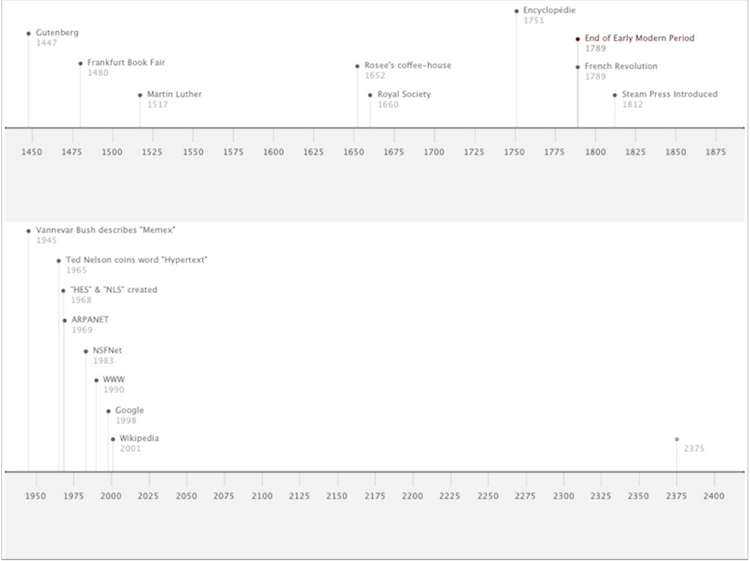
I always appreciate how Geoffrey Bilder can manage to talk about the Social Semantic Web and the early modern print in (nearly) the same breath. See for yourself in the presentation he gave to scholarly publishers at the International Society of Managing and Technical Editors last month.

Geoff’s presentation is outlined, to a large extent, in an interview Geoff gave 18 months ago (search “key messages” to find the good bits). I hope to blog further about these, because Geoff has so many good things to say, which deserve unpacking!

I especially love the timeline from slide 159, which shows that we’re just past the incunabula age of the Internet:

The Early Modern Internet

We're still in the Early Modern era of the Internet. Compare to the history of print.

Tags: , , , , , ,
Posted in future of publishing, information ecosystem, PhD diary, scholarly communication, semantic web, social semantic web, social web | Comments (3)

Accessing genomics workflows from Word documents with GenePattern

November 14th, 2010
by jodi

What if you could rerun computational experiments from within a scientific paper?

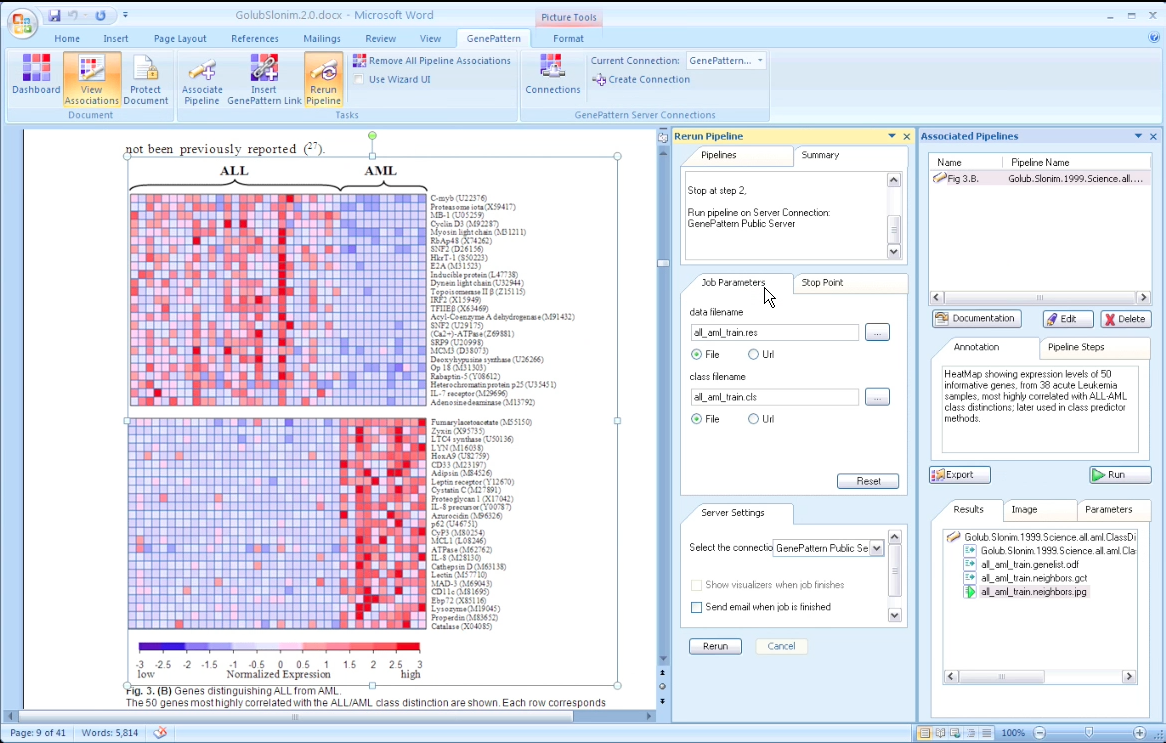
The GenePattern add-on for Word for Windows integrates reusable genomic experiment pipelines into Microsoft Word. Readers can rerun the original or modified experiments from within the document by connecting to a GenePattern server.

Rerunning a pipeline inside Word

Rerunning a pipeline inside Word

I don’t run Windows, so I took this screenshot from a video produced at the Broad Institute of MIT and Harvard, where GenePattern is developed.

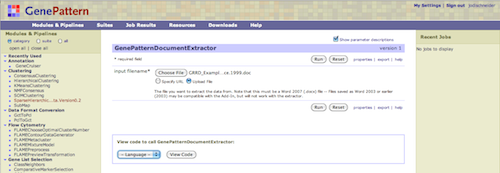
Readers without Word for Windows can also access the experimental pipelines by exporting them from the document: just run a GenePatternDocumentExtractor command from a GenePattern server. The GenePattern public server was very easy to access and start using. Here’s what the GenePatternDocumentExtractor command looks like:

Running GenePatternDocumentExtractor at the GenePattern public server

Running GenePatternDocumentExtractor at the GenePattern public server

Unfortunately the jobs I ran didn’t extract any pipelines from the Institute’s sample DOC. I’ve sent in an inquiry (either I’m doing something wrong or there’s a bug, either way it’s useful). I was very impressed that I could make my jobs public, then refer to them by URL in my email, to make clear what exactly I did.

The GenePattern add-on for Word is another find from the beyondthepdf list. Its development was funded by Microsoft. See also Accessible Reproducible Research by Jill P. Mesirov (Science, 327:415, 2010). doi:10.1126/science.1179653, which describes the underlying philosophy: have a Reproducible Research System (RRS) made up of an environment for doing computational work (the Reproducible Research Environment or RRE) and an authoring environment (the Reproducible Research Publisher or RRP) which links back to the research system.

Tags: , , , , , ,
Posted in books and reading, future of publishing, information ecosystem, scholarly communication | Comments (1)

Utopia Documents: pulling scientific data into the PDF for interactive exploration

November 14th, 2010
by jodi

What if data were accessible within the document itself?

Utopia Documents is a free PDF viewer which recognizes certain enhanced figures, and fetches the underlying data. This allows readers to view and experiment with the tables, graphs, molecular structures, and sequences in situ.


You can download Utopia Documents for Mac and Windows to view enhanced papers, such as those published in The Semantic Biochemical Journal.

These screencasts were made from pages 9 and 10 of PDF of a paper by the Manchester-based Utopia team: T. K. Attwood, D. B. Kell, P. Mcdermott, J. Marsh, S. R. Pettifer, and D. Thorne. Calling international rescue: knowledge lost in literature and data landslide! Biochemical Journal, Dec 2009. doi:10.1042/BJ20091474.

In an interview at the Guardian, Utopia’s Phillip McDermott says:

“Utopia Documents links scientific research papers to the data and to the community. It enables publishers to enhance their publications with additional material, interactive graphs and models. It allow the reader to access a wealth of data resources directly from the paper they are viewing, makes private notes and start public conversations. It does all this on normal PDFs, and never alters the original file. We are targeting the PDF, since they still have around 80% readership over online viewing.

“Semantics, loose-coupling, fingerprinting and linked-data are the key ingredients. All the data is described using ontologies, and a plug-in system allows third parties to integrate their database or tool within a few lines of script. We use fingerprinting to allow us to recognise what paper a user is reading, and to spot duplicates. All annotations are held remotely, so that wherever you view a paper, the result is the same.”

I’d still like to see a demo of the commenting functionality.

I’d also be particularly interested in the publisher perspective, about the production work that goes into creating the enhancements. Portland Press’s October news announces that they’ve been promoting Utopia at the Charleston conference and SSP, with an upcoming appearance at the STM Innovations Seminar.

Utopia came to my attention via Steve Pettifer’s mention.

Tags: , , , , , , , , ,
Posted in future of publishing, information ecosystem, library and information science, scholarly communication, semantic web, social semantic web | Comments (4)

A Model-View-Controller perspective of scholarly articles

November 13th, 2010
by jodi

A scholarly paper is not a PDF. A PDF is merely one view of a scholarly paper. To push ‘beyond the PDF’, we need design patterns that allow us to segregate the user interface of the paper (whether it is displayed as an aggregation of triples, a list of assertions, a PDF, an ePub, HTML, …) from the thing itself.

Towards this end, Steve Pettifer has a Model-View-Controller perspective on scholarly articles, which he shared in a post on the Beyond the PDF listserv, where discussions are leading up to a workshop in January. I am awe-struck: I wish I’d thought of this way of separating the structure and explaining it.

I think a lot of the disagreement about the role of the PDF can be put down to trying to overload its function: to try to imbue it with the qualities of both ‘model’ and ‘view’. … One of the things that software architects (and I suspect designers in general) have learned over the years is that if you try to give something functions that it shouldn’t have, you end up with a mess; if you can separate out the concerns, you get a much more elegant and robust solution.

My personal take on this is that we should keep these things very separate, and that if we do this, then many of the problems we’ve been discussing become more clearly defined (and I hope, many of the apparent contradictions, resolved).

So… a PDF (or come to that, an e-book version or a html page) is merely a *view* of an article. The article itself (the ‘model’) is a completely different (and perhaps more abstract) thing. Views can be tailored for a particular purpose, whether that’s for machine processing, human reading, human browsing, etc etc.

[paragraph break inserted]

The relationship between the views and their underlying model is managed by the concept of a ‘controller’. For example, if we represent an article’s model in XML or RDF (its text, illustrations, association nanopublications, annotations and whatever else we like), then that model can be transformed in to any number of views. In the case of converting XML into human-readable XHTML, there are many stable and mature technologies (XSLT etc). In the case of doing the same with PDF, the traditional controller is something that generates PDFs.

[paragraph break inserted]

The thing that’s been (somewhat) lacking so far is the two-way communication between view and model (via controller) that’s necessary to prevent the views from ossifying and becoming out of date (i.e. there’s no easy way to see that comments have been added to the HTML version of an article’s view if you happen to be reading the PDF version, so the view here can rapidly diverge from its underlying model).

[paragraph break inserted, link added]

Our Utopia software is an attempt to provide this two-way controller for PDFs. I believe that once you have this bidirectional relationship between view and model, then the actual detailed affordances of the individual views (i.e. what can a PDF do well / badly, what can HTML do well / badly) become less important. They are all merely means to channeling the content of an article to its destination (whether that’s human or machine).

The good thing about having this ‘model view controller’ take on the problem is that only the model needs to be pinned down completely …

Perhaps separating out our concerns in this way — that is, treating the PDF as one possible representation of an article — might help focus our criticisms of the current state of affairs? I fear at the moment we are conflating the issues to some degree.

– Steve Pettifer in a Beyond the PDF listserv post

I’m particularly interested in hearing if this perspective, using the MVC model, makes sense to others.

Tags: , , , , , , ,
Posted in books and reading, future of publishing, information ecosystem, library and information science, scholarly communication, social semantic web | Comments (9)

A Taxonomy for Decisions

November 4th, 2010
by jodi

Tim van Gelder provides a taxonomy for decisions:

  1. Intuitive Decisions
  2. Technical Decisions
  3. Deliberative Decisions
  4. Bureaucratic Decisions

Deliberative and bureaucratic decisions are, I think, the most important for collaborative decision-making. Intuitive decisions, made quickly by an individual, are least important for collaboration. Technical decisions have the most interesting description: they are “made by following some well-defined technical procedure”; arguably they are not decisions.

Can you spot any overlaps or gaps? Discuss at his article.

The argumentation community has given a lot of attention to deliberation; I wonder if that has been influenced by the prevalence of deliberation in decision-making, and the difficulty of formal modelling of bureaucracies.

Tags: ,
Posted in argumentative discussions, PhD diary | Comments (0)

blog ‘reactions’

November 2nd, 2010
by jodi

Instead of enabling commenting on your blog, you can let readers ‘react’ by marking the post as ‘funny’, ‘interesting’, or ‘cool’. So far I’ve only seen this on one Blogspot blog, Galway Library’s blog.

Reactions to a blog post

Is this post funny, interesting, or cool?


If you know whether there’s a plugin doing this, or if it’s a general (optional) Blogspot feature, please let me know in the comments.

Tags: , , ,
Posted in argumentative discussions, PhD diary, social web | Comments (1)

Ebook pricing fail (Springer edition)

November 1st, 2010
by jodi

I wrote Springer to ask about buying an ebook that’s not in our university subscriptions. They sell the print copy at €62.95, but the electronic copy comes to €425, chapter by chapter.

Publishers: this is short-sighted (not to mention frustrating)–especially when your customers are looking for a portable copy of a book they already owns!

———- Forwarded message ———-
From: Springerlink, Support, Springer DE
Date: Fri, Oct 29, 2010 at 8:46 PM
Subject: WG: ebook pricing

Dear Jodi,

Thank you for your message.

On SpringerLink you can purchase online single journal articles and book chapters, but no complete ebooks.
eBooks are sold by Springer in topical eBook packages only.

with kind regards,
SpringerLink Support Team
eProduct Management & Innovation | SpringerLink Operations
support.springerlink@springer.com | + 49 (06221) 4878 743
www.springerlink.com

—–Original Message—–
From: Jodi Schneider
Sent: Thursday, October 28, 2010 5:09 PM
To: MetaPress Support
Subject: ebook pricing

Hi,

I’m interested in buying a copy of [redacted] as an ebook:
http://www.springerlink.com/content/[redacted]

This book has 17 chapters, which seem to be priced at 25 EUR each = 425 EUR.

But I could buy a print version, new at springer.com for 62.95 EUR:
http://www.springer.com/mathematics/book/[redacted]

Can you help me get the ebook at this price?
Thanks!
-Jodi

Tags: , , , ,
Posted in books and reading, future of publishing | Comments (3)

“Like” and its misuse

October 20th, 2010
by jodi

Language evolves, and we use words loosely. But I’m more and more disturbed with the way “Like” is being manhandled.
A misuse of the Like button
Argumentation will need to encompass polarity; so I hope that it can help.

Tags: , , , ,
Posted in argumentative discussions, PhD diary, random thoughts | Comments (4)

CiTO in the wild

October 18th, 2010
by jodi

CiTO has escaped the lab and can now be used either directly in the CiteULike interface or with CiteULike machine tags. Go Citation Typing Ontology!

In the CiteULike Interface

To add a CiTO relationship between articles using the CiteULike interface, both articles must be in your own library. You’ll see a a “Citations (CiTO)” section after your tags. Click on edit and set the current article as the target.

set the CiTO target

First set the CiTO target

Then navigate around your own library to find a related article. Now you can add a CiTO tag.

Adding a CiTO tag in CiteULike

Adding a CiTO tag in CiteULike

There are a lot of choices. Choose just one. :)

CiTO Object Properties appear in the dropdown

CiTO Object Properties now appear in the dropdown

Congratulations, you’ve added a CiTO relationship! Now mousing over the CiTO section will show details on the related article.

CiTO result

Mouse over the resulting CiTO tag to get details of the related article

Machine Tags

Machine tags take fewer clicks but a little more know-how. They can be added just like any other tag, as long as you know the secret formula: cito--(insert a CiTO Object Property here from this list)--(insert article permalink numbers here) Here are two more concrete examples.

First, we can keep a list of articles citing a paper. For example, tagging an article

cito--cites--1375511

says “this article CiTO:cites article 137511”. Article 137511 can be found at http://www.citeulike.org/article/137511, aka JChemPaint – Using the Collaborative Forces of the Internet to Develop a Free Editor for 2D Chemical Structures. Then we can get the list of (hand-tagged) citations to the article. Look—a community generated reverse citation index!

Second, we can indicate specific relationships between articles, whether or not they cite each other. For example, tagging an article

cito--usesmethodin--423382

says “this item CiTO:usesmethodin item 42338”. Item 42338 is found at http://www.citeulike.org/article/423382, aka The Chemistry Development Kit (CDK):  An Open-Source Java Library for Chemo- and Bioinformatics.

Upshot

Automation and improved annotation interfaces will make CiTO more useful. CiTO:cites and CiTO:isCitedBy could used to mark up existing relationships in digital libraries such as ACM Digital Library and CiteSeer, and could enhance collections like Google Books and Mendeley, to make human navigation and automated use easier. To capture more sophisticated relationships, David Shotton has hopes of authors marking up citations before submitting papers; if it’s required, anything is possible. Data curators and article commentators may observe contradictions between papers, or methodology reuses; in these cases CiTO could be layered with an annotation ontology such as AO in order to make the provenance of such assertions clear.

CiTO could put pressure on existing publishers and information providers to improve their data services, perform more data cleanup, or to exposing bibliographies in open formats. Improved tools will be needed, as well as communities that are willing to add data by hand, and algorithms for inferring deep citation relationships.

One remaining challenge is aggregation of CiTO relationships between bibliographic data providers; article identifiers such as DOI are unfortunately not universal, and the bibliographic environment is messy, with many types of items, from books to theses to white papers to articles to reports. CiTO and related ontologies will help explicitly show the bibliographic web and relationships between these items, on the web of (meta)data.

Further Details

CiTO is part of an ecosystem of citations called Semantic Publishing and Referencing Ontologies (SPAR); see also the JISC Open Citation Project which is taking bibliographic data to the Web, and the JISC Open Bibliography Project. For those familiar with Shotton’s earlier writing on CiTO, note that SPAR breaks out some parts of the earlier formulation of this ontology.

Tags: , , , , ,
Posted in argumentative discussions, books and reading, information ecosystem, library and information science, PhD diary, scholarly communication, semantic web | Comments (3)