To support reading, think about diversity of reading styles.
A study of “How examiners assess research theses” mentions the diversity:
[F]our examples give a good indication of the range of ‘reading styles’:
A (Hum/Male/17) sets aside time to read the thesis. He checks who is in the references to see that the writers are there who should be there. Then he reads slowly, from the beginning like a book, but taking copious notes.
B (Sc/Male/22) reads the thesis from cover to cover first without doing anything else. For the first read he is just trying to gain a general impression of what the thesis is about and whether it is a good thesis—that is, are the results worthwhile. He can also tell how much work has actually been done. After the first read he then ‘sits on it’ for a while. During the second reading he starts making notes and reading more critically. If it is an area with which he is not very familiar, he might read some of the references. He marks typographical errors, mistakes in calculations, etc., and makes a list of them. He also checks several of the references just to be sure they have been used appropriately.
C (SocSc/Female/27) reads the abstract first and then the introduction and the conclusion, as well as the table of contents to see how the thesis is structured; and she familiarises herself with appendices so that she knows where everything is. Then she starts reading through; generally the literature review, and methodology, in the first weekend, and the findings, analysis and conclusions in the second weekend. The intervening week allows time for ideas to mull over in her mind. On the third weekend she writes the report.
D (SocSc/Male/15) reads the thesis from cover to cover without marking it. He then schedules time to mark it, in about three sittings, again working from beginning to end. At this stage he ‘takes it apart’. Then he reads the whole thesis again.
I spoke about my first year Ph.D. research in December at DERI. The topic of my talk: Wikipedia discussions and the nascent World Wide Argument Web. I was proud to have the video (below) posted to our institute video stream.
The Wikipedia research is drawn from our ACM Symposium on Applied Computing paper:
Jodi Schneider, Alexandre Passant, John G. Breslin, “Understanding and Improving Wikipedia Article Discussion Spaces.” In SAC 2011 (Web Track), TaiChung, Taiwan, March 21-25, 2011.
Can you distinguish what is being said from how it is said?
In other words, what is a ‘proposition’?
Giving an operational definition of ‘proposition’ or of ‘propositional content’ is difficult. Turns out there’s a reason for that:
Metadiscourse does not simply support propositional content: it is the means by which propositional content is made coherent, intelligible and persuasive to a particular audience.
– Ken Hyland Metadiscourse p39 ((I’m really enjoying Ken Hyland’s Metadiscourse. Thanks to Sean O’Riain for a wonderful loan! I’m not ready to summarize his thoughts about what metadiscourse is — for one thing I’m only halfway through.)).
I’m very struck by how the same content can be wrapped with different metadiscourse — resulting in different genres for distinct audiences. When the “same” content is reformulated, new meanings and emphasis may be added along the way. Popularization of science is rich in examples.
For instance, a Science article…
When branches of the host plant having similar oviposition sites were placed in the area, no investigations were made by the H. hewitsoni females.
gets transformed into a Scientific American article…
I collected lengths of P. pittieri vines with newly developed shoots and placed them in the patch of vines that was being regular revisited. The females did not, however, investigate the potential egg-laying sites I had supplied.
This shows the difficulty of making clean separations between the content and the metadiscourse:
“The ‘content’, or subject matter, remains the same but the meanings have changed considerably. This is because the meaning of a text is not just about the propositional material or what the text could be said to be about. It is the complete package, the result of an interactive process between the producer and receiver of a text in which the writer chooses forms and expressions which will best convey his or her material, stance and attitudes.
– Ken Hyland Metadiscourse p39
Example from Hyland (page 21), which credits Myers Writing Biology: Texts in the Social Construction of Scientific Knowledge 1990 (180).
Apple’s press release about its “new subscription services” seems at first innocuous, and the well-crafted quote ((
“Our philosophy is simple—when Apple brings a new subscriber to the app, Apple earns a 30 percent share; when the publisher brings an existing or new subscriber to the app, the publisher keeps 100 percent and Apple earns nothing,” said Steve Jobs, Apple’s CEO. “All we require is that, if a publisher is making a subscription offer outside of the app, the same (or better) offer be made inside the app, so that customers can easily subscribe with one-click right in the app. We believe that this innovative subscription service will provide publishers with a brand new opportunity to expand digital access to their content onto the iPad, iPod touch and iPhone, delighting both new and existing subscribers.”
– Steve Jobs at “Apple Launches Subscriptions on the App Store“)) from Steve Jobs has been widely reposted:
“when Apple brings a new subscriber to the app, Apple earns a 30 percent share; when the publisher brings an existing or new subscriber to the app, the publisher keeps 100 percent and Apple earns nothing.” Yet analysts reading between the lines have been less than pleased.
Apple takes a 30% cut of all in-app purchases ((Booksellers call this “the agency model“.))
Apps may not bypass in-app purchase: apps may not link to an external website (such as Amazon) ((Apple has confirmed that Kindle’s “Shop in Kindle Store” must be removed.)) that allows customers to buy content or subscriptions.
Content available for purchase in the app cannot be cheaper elsewhere.
The customer’s demographic information resides with Apple, not with the publisher. Customers must opt-in to share their name, email, and zipcode with the publisher, though Apple will of course have this information.
Reduction of content available in apps (likely for the near-term).
More complex, clunky purchase workflows (possible).
Publishers may sell material only outside of apps, from their own website, to avoid paying 30% to Apple. Will we see a proliferation of publisher-run stores?
Price increases to cover Apple’s commission (likely).
If enacted, these must apply to all customers, not just iOS device users.
The upside? Device-independent HTML5 apps may see wider adoption. HTML5 mobile apps work well on iOS, on other mobile platforms, and on laptops and desktops.
For ebooks, HTML5 means Ibis Reader and Book.ish. For publishers looking to break free of Apple, yet satisfy customers, Ibis Reader may be a particularly good choice: this year they are focusing on licensing Ibis Reader, as Liza Daly’s Threepress announced in a savvy and well-timed post, anticipating Apple’s announcement. Having been a beta tester of Ibis Reader, I can recommend it!
If you know of other HTML5 ebook apps, please leave them in the comments.
Yesterday I spoke at Beyond the PDF about use cases for reading. Slides are below; the presentation was also webcast, so I hope to share a video recording when it becomes available. The video is now on Youtube (part of the Beyond the PDF video playlist) and below.
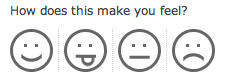
GetSatisfaction‘s “How does this make you feel?” intrigues me: why do people answer this? Conventional wisdom says that people don’t classify their posts.
Presumably it’s polite to ask people how they’re doing — at least in some situations. And technically there’s no post classification going on here: it’s mood classification, which most of us are trained in from a young age.
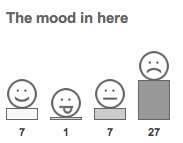
Get Satisfaction aggregates the mood on each discussion thread:
Nicole Henning suggests that academic libraries and scholarly presses work together to create the ultimate mobile app for scholarly ereading. I think about the requirements a bit differently, in terms of the functional requirements.
The main functions are obtaining materials, reading them, organizing them, keeping them, and sharing them.
For obtaining materials, the key new requirement is to simplify authentication: handle campus authentication systems and personal subscriptions. Multiple credentialed identities should be supported. A secondary consideration is that RSS feeds (e.g. for journal tables of contents) should be supported.
For reading materials, the key requirement is to support multiple formats in the same application. I don’t know of a web app or mobile app that supports PDF, EPUB, and HTML. Reading interfaces matter: look to Stanza and Ibis Reader for best-in-class examples.
For organizing materials, the key is synergy between the user’s data and existing data. Allow tags, folders, and multiple collections. But also leverage existing publisher and library metadata. Keep it flexible, allowing the user to modify metadata for personal use (e.g. for consistency or personal terminology) and to optionally submit corrections.
For keeping materials, import, export, and sync content from the user’s chosen cloud-based storage and WebDAV servers. No other device (e.g. laptop or desktop) should be needed.
For sharing materials, support lightweight micropublishing on social networks and email; networks should be extensible and user-customizable. Sync to or integrate with citation managers and social cataloging/reading list management systems.
Regardless of the ultimate system, I’d stress that device independence is important, meaning that an HTML5 website would probably the place to start: look to Ibis Reader as a model.
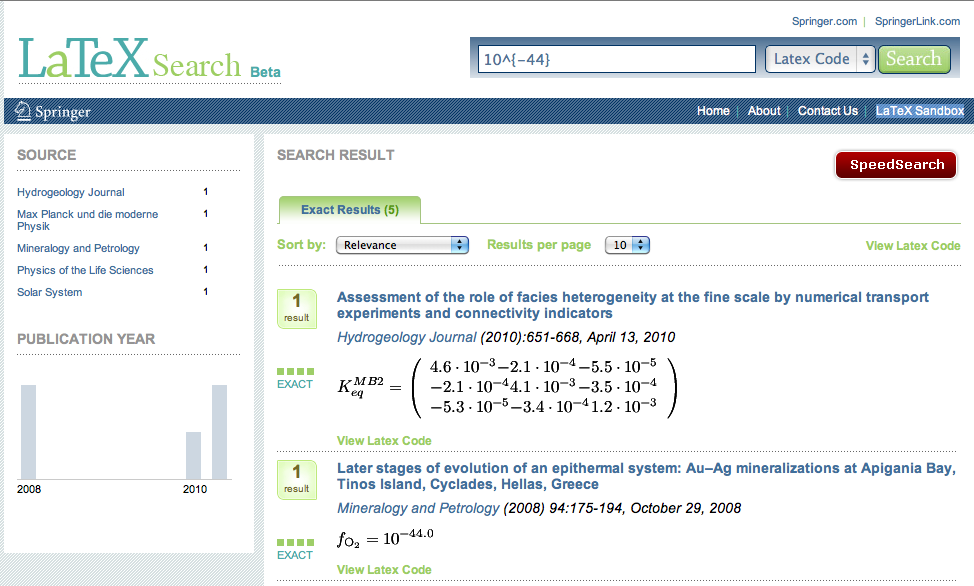
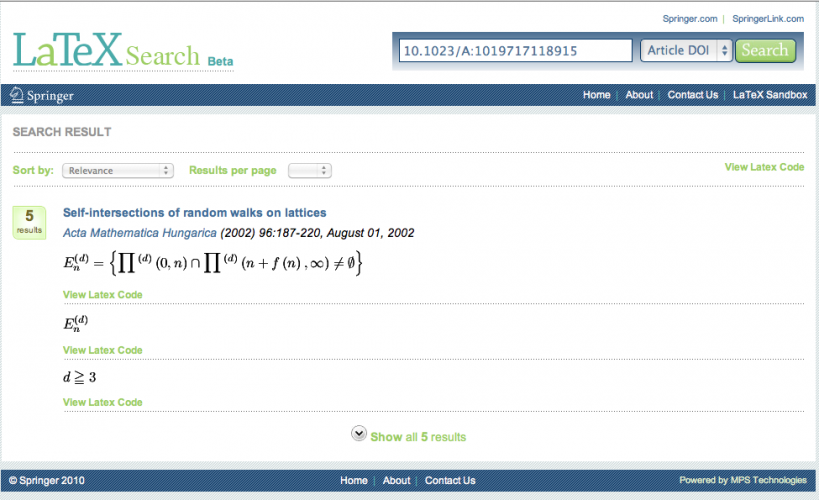
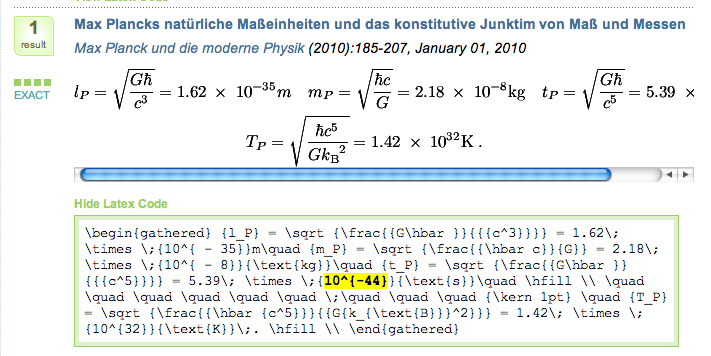
Springer’s LaTeX search service (example results) allow searching for LaTeX strings or finding the LaTeX equations in an article. Since LaTeX is used to markup equations in many scientific publications this could be an interesting way to find related work or view an equation-centric summary of a paper.
You can provide a LaTeX string, and Springer says that besides exact matches they can return similar LaTeX strings:
Or, you can search by DOI or title to get all the equations in a given publication:
Under each equation in the search results you can click “show LaTeX code”:
Right now it just searches Springer’s publications; Springer would like to add open access databases and preprint servers. Coverage even in Springer journals seems spotty: I couldn’t find two particular discrete math articles papers, so I’ve written Springer for clarification. As far as I can tell, there’s no way to get from SpringerLink to this LaTeX search yet: it’s a shame, because “show all equations in this article” would be useful, even with the proviso that only LaTeX equations were shown.
A nice touch is their sandbox where you can test LaTeX code, with a LaTeX dictionary conveniently below.
Today, in many countries around the world, new works become public property: January 1st every year is Public Domain Day. Material in the public domain can be used, remixed and shared freely — without violating copyright and without asking permission.
However, in the United States, not a single new work entered the public domain today. Americans must wait 8 more years: Under United States copyright law, nothing more will be added to the public domain until January 1, 2019.
Until the 1970’s the maximum copyright term was 56 years. Under that law, Americans would have been able to truly celebrate Public Domain Day:
All works published in 1954 would be entering the public domain today.
up to 85% of all copyrighted works from 1982 would be entering the public domain today. (Copyright Office and Duke).
Instead, only works published before 1923 are conclusively in the public domain in the U.S. today. What about post-1923 publications? It’s complicated: in the United States ((609 pages worth of complicated)).