Language evolves, and we use words loosely. But I’m more and more disturbed with the way “Like” is being manhandled.

Argumentation will need to encompass polarity; so I hope that it can help.
“Like” and its misuse
October 20th, 2010
Tags: argumentation, argumentation ontologies, Facebook, like, semantics
Posted in argumentative discussions, PhD diary, random thoughts | Comments (4)
CiTO in the wild
October 18th, 2010
CiTO has escaped the lab and can now be used either directly in the CiteULike interface or with CiteULike machine tags. Go Citation Typing Ontology!
In the CiteULike Interface
To add a CiTO relationship between articles using the CiteULike interface, both articles must be in your own library. You’ll see a a “Citations (CiTO)” section after your tags. Click on edit and set the current article as the target.

First set the CiTO target
Then navigate around your own library to find a related article. Now you can add a CiTO tag.
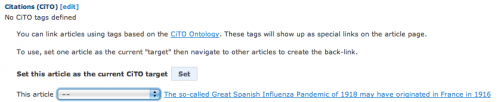
Adding a CiTO tag in CiteULike
There are a lot of choices. Choose just one. :)
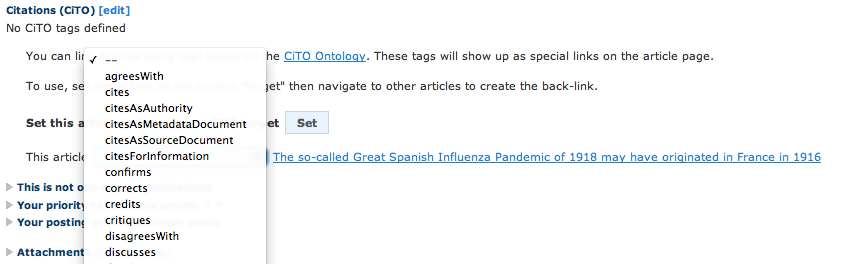
CiTO Object Properties now appear in the dropdown
Congratulations, you’ve added a CiTO relationship! Now mousing over the CiTO section will show details on the related article.
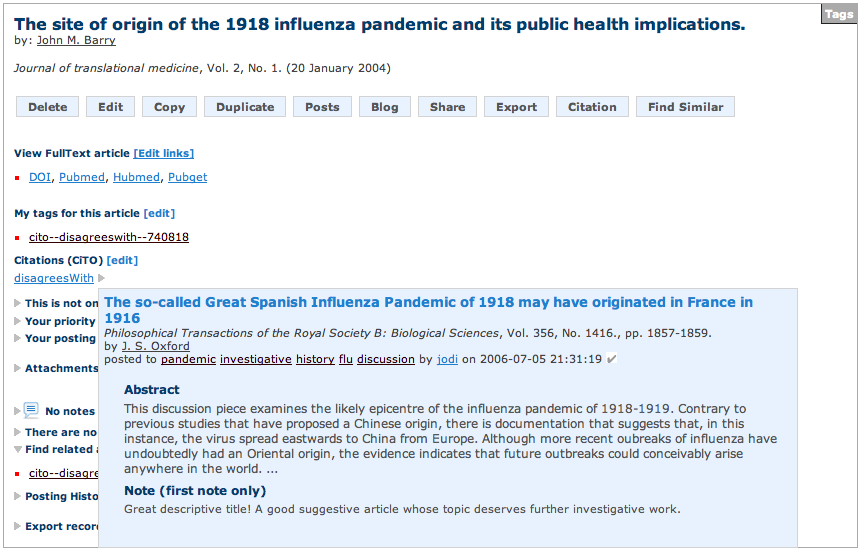
Mouse over the resulting CiTO tag to get details of the related article
Machine Tags
Machine tags take fewer clicks but a little more know-how. They can be added just like any other tag, as long as you know the secret formula: cito--(insert a CiTO Object Property here from this list)--(insert article permalink numbers here) Here are two more concrete examples.
First, we can keep a list of articles citing a paper. For example, tagging an article
cito--cites--1375511
says “this article CiTO:cites article 137511”. Article 137511 can be found at http://www.citeulike.org/article/137511, aka JChemPaint – Using the Collaborative Forces of the Internet to Develop a Free Editor for 2D Chemical Structures. Then we can get the list of (hand-tagged) citations to the article. Look—a community generated reverse citation index!
Second, we can indicate specific relationships between articles, whether or not they cite each other. For example, tagging an article
cito--usesmethodin--423382
says “this item CiTO:usesmethodin item 42338”. Item 42338 is found at http://www.citeulike.org/article/423382, aka The Chemistry Development Kit (CDK): An Open-Source Java Library for Chemo- and Bioinformatics.
Upshot
Automation and improved annotation interfaces will make CiTO more useful. CiTO:cites and CiTO:isCitedBy could used to mark up existing relationships in digital libraries such as ACM Digital Library and CiteSeer, and could enhance collections like Google Books and Mendeley, to make human navigation and automated use easier. To capture more sophisticated relationships, David Shotton has hopes of authors marking up citations before submitting papers; if it’s required, anything is possible. Data curators and article commentators may observe contradictions between papers, or methodology reuses; in these cases CiTO could be layered with an annotation ontology such as AO in order to make the provenance of such assertions clear.
CiTO could put pressure on existing publishers and information providers to improve their data services, perform more data cleanup, or to exposing bibliographies in open formats. Improved tools will be needed, as well as communities that are willing to add data by hand, and algorithms for inferring deep citation relationships.
One remaining challenge is aggregation of CiTO relationships between bibliographic data providers; article identifiers such as DOI are unfortunately not universal, and the bibliographic environment is messy, with many types of items, from books to theses to white papers to articles to reports. CiTO and related ontologies will help explicitly show the bibliographic web and relationships between these items, on the web of (meta)data.
Further Details
CiTO is part of an ecosystem of citations called Semantic Publishing and Referencing Ontologies (SPAR); see also the JISC Open Citation Project which is taking bibliographic data to the Web, and the JISC Open Bibliography Project. For those familiar with Shotton’s earlier writing on CiTO, note that SPAR breaks out some parts of the earlier formulation of this ontology.
Tags: argumentation ontologies, bibliographic data, Citation Typing Ontology, CiteULike, CITO, semantic libraries
Posted in argumentative discussions, books and reading, information ecosystem, library and information science, PhD diary, scholarly communication, semantic web | Comments (3)
Enabling a Social Semantic Web for Argumentation (defining my Ph.D. research problem)
July 23rd, 2010
I’m working on online argumentation: Making it easier to have discussions, get to consensus, and understand disagreements across websites.
Here are the 3 key questions and the most closely related work that I’ve identified in the first 9 months of my Ph.D.
Read on, if you want to know more. Then let me know what you think! Suggestions will be especially helpful since I’m writing my first year Ph.D. report, which will set the direction for my second year at DERI.
Enabling a Social Semantic Web for Argumentation
Argumentative discussions occur informally throughout the Web, however there is currently no way of bringing together all of the discussions on a given topic along with an indication of who is agreeing and who is disagreeing. Thus substantial human analysis is required to integrate opinions and expertise to, for instance, determine the best policies and procedures to mitigate global warming, or the recommended treatment for a given disease. New techniques for gathering and organising the Social Web using ontologies such as FOAF and SIOC show promise for creating a Social Semantic Web for argumentation.
I am currently investigating three main research questions to establish the Social Semantic Web for argumentation:
- How can we best define argumentation for the Social Semantic Web, to isolate the essential problems? We wish to enable reasoning with inconsistent knowledge, to integrate disparate knowledge, and identify consensus and disputes. Similar questions and techniques come up in related but distinct areas, such as sentiment analysis, dialogue mapping, dispute resolution, question-answering and e-government participation.
- What sort of modular framework for argumentation can support distributed, emergent argumentation — a World Wide Argumentation Web? Some Web 2.0 tools, such as Debatepedia, LivingVote, and Debategraph, provide integrated environments for explicit argumentation. But our goal is for individuals to be able to use their own preferred tools — in a social environment — while understanding what else is being discussed.
- How can we manage the tension between informality and ease of expression on the one hand and formal semantics and retrievability/reusability on the other hand? Minimal integration of informal arguments requires two pieces of information: a statement of the issue or proposition, and an indication of polarity (agreement or disagreement). How can we gather this information without adding cognitive overhead for users?
Related Work
Ennals et al. ask: ‘What is disputed on the Web? (Ennals 2010b). They use annotation and NLP techniques to develop a prototype system for highlighting disputed claims in Web documents (Ennals 2010a). Cabanac et al. find that two algorithms for identifying the level of controversy about an issue were up to 84% accurate (compared to human perception), on a corpus of 13 arguments. These are useful prototypes of what could be done; Ennals prototype is indeed a Web-scale system, but disputed claims are not arguments.
Rahwan et al. (2007) present a pilot Semantic Web-based system, ArgDF, in which users can create arguments, and query to find networks of arguments. ArgDF is backed with the AIF-RDF ontology, and uses Semantic Web standards. Rahwan (2008) surveys current Web2.0 tools, pointing out that integration between these tools is lacking, and that only very shallow argument structures are supported; ArgDF and AIF-RDF are explained as an improvement. What is lacking is uptake in end-user orientated (e.g. Web 2.0) tools.
The Web2.0 aspect of the problem is explored in several papers, including Buckingham Shum (2008), which presents Cohere, a Web2.0-style argumentation system supporting existing (non-Semantic Web) argumentation standards, and Groza et al. (2009) which proposes a abstract framework for modeling argumentation. These are either minimally implemented frameworks or stand-alone systems which do not yet support the distributed, emergent argumentation envisioned, as further elucidated by Buckingham Shum (2010).
References with links to preprints
- S. Buckingham Shum, “Cohere: Towards Web 2.0 Argumentation,” Computational Models of Argument – Proceedings of COMMA 2008, IOS Press, 2008.
- S. Buckingham Shum, AIF Use Case: Iraq Debate, Glenshee, Scotland, UK: 2010. http://projects.kmi.open.ac.uk/hyperdiscourse/docs/AIF-UseCase-v2.pdf
- G. Cabanac, M. Chevalier, C. Chrisment, and C. Julien, “Social validation of collective annotations: Definition and experiment,” Journal of the American Society for Information Science and Technology, vol. 61, 2010, pp. 271-287.
- R. Ennals, B. Trushkowsky, and J.M. Agosta, “Highlighting Disputed Claims on the Web,” WICOW 2010, Raleigh, North Carolina: 2010.
- R. Ennals, D. Byler, J.M. Agosta, and Barboara Rosario, “What is Disputed on the Web?,” WWW 2010, Raleigh, North Carolina: 2010.
- T. Groza, S. Handschuh, J.G. Breslin, and S. Decker, “An Abstract Framework for Modeling Argumentation in Virtual Communities,” International Journal of Virtual Communities and Social Networking, vol. 1, Sep. 2009, pp. 35-47.
- I. Rahwan, “Mass argumentation and the semantic web,” Web Semantics: Science, Services and Agents on the World Wide Web, vol. 6, Feb. 2008, pp. 29-37.
- I. Rahwan, F. Zablith, and C. Reed, “Laying the foundations for a World Wide Argument Web,” Artificial Intelligence, vol. 171, Jul. 2007, pp. 897-921.
Tags: DERI, first year report
Posted in argumentative discussions, PhD diary, semantic web, social semantic web, social web | Comments (1)
Quoted in Inside Higher Ed
July 17th, 2010
Earlier this week, Inside Higher Ed published an article about wikis in higher education. I’m quoted in connection with my work ((I used to be AcaWiki’s Community Liaison and now contribute summaries and help administer the wiki.)) with AcaWiki, which gathers summaries of research papers, books, etc.
The article was publicized with a tweet asking “Why haven’t #wikis revolutionized scholarship?”
Of course, I’d rather ask “how have wikis impacted scholarship?” — though that’s less sexy! First, the largest impact is in technological infrastructure: it’s now commonplace to use collaborative, networked tools with built-in version control. (Though “wiki” isn’t what we’d use to describe Google Docs nor Etherpad or its many clones). Second, wikis are ubiquitous in research, if you look in the right places. (nLab, OpenWetWare, and numerous departmental wikis). Third, “revolutions” take time, and academia is essentially conservative and slow-moving. For instance, ejournals (~15 years old and counting) are only just starting to depart significantly from the paper form (with multimedia inclusions, storage of data and other, public comments, overlay journals, post-publication peer-review, etc). Wikis have been used for teaching since roughly 2002 ((see e.g. Bergin, J. (2002). Teaching on the wiki web. In Proceedings of the 7th annual conference on Innovation and technology in computer science education (pp. 195-195). Aarhus, Denmark: ACM. doi:10.1145/544414.544473 and related source code)), meaning that academic wikis might be only about 8 years old at this point.
Other responses: Viva la wiki, says Brian Lamb, who was also interviewed for the article. Daniel Mietchen thinks big about the future of wikis for science.
.
Tags: acawiki, Inside Higher Ed, wikis
Posted in future of publishing, higher education, information ecosystem, scholarly communication | Comments (0)
Funding Models for Books
July 17th, 2010
Paying for books per copy “developed in response to the invention of the printing press”, and a Readercon panel discussed some alternatives.
Existing alternatives, as noted in Cecilia Tan’s summary of the panel:
- the donation model
- the Kickstarter model
- the “ransom” model
- the subscription or membership model
- the “perks” model
- the merchandising model
- the collectibles model
- the company or support grant model
- the voting model
- the hits/pageviews model
Any synergies with Kevin Kelly’s Better than Free?
Tags: business models, economics, pay-per-copy
Posted in books and reading, future of publishing | Comments (0)
DERI “Research Explained” video series
July 15th, 2010
Word has gotten out about DERI’s “Research Explained” video series, which I’m narrating. These videos explain DERI’s Semantic Web research to a broad audience, so far in three areas: mobile/social sensing, expert finding, and semantic search.
James Lyng, Julie Letierce, Brendan Smith, and Dr. Brian Wall produce these videos with in collaboration with DERI scientists. Drawings are by Eoghan Hynes and James Lyng.
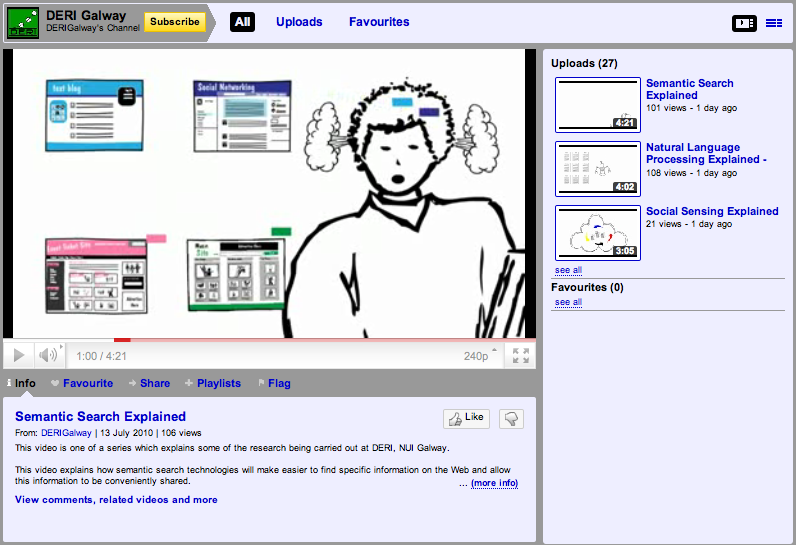
Watch the series at DERI Galway’s youtube video channel.
My voiceover role came thanks to Julie’s instigation, since I had narrated a screencast for our colleague Peyman Nasirifard’s Conterprise project.
Tags: DERI, screencasts, videos, voiceovers
Posted in scholarly communication, semantic web | Comments (0)
Book as experience? Or book as storage/retrieval mechanism?
June 24th, 2010
Here’s a research question for historians of the book (and maybe book futurists, too):
What’s the key aspect of the book?
- the cognitive experience
- information storage and retrieval enabled (e.g. book features such as ToC & indexes within a book itself; reproducibility of ‘exact’ copies, wider distribution and ownership of books, ability to have multiple books on the shelf, etc.)?
That arises from Steven Berlin Johnson:
[W]as the intellectual revolution post-Gutenberg driven by the mental experience of long-form reading? Or was it driven by the ability to share information asynchronously, and transmit that information easily around the globe? I think it is a mix of the two, but Nick, taking his cues from McLuhan, places almost all of his emphasis on the cognitive effects of deep focus reading. There’s no real way to prove it, but I think there’s a very strong case to be made that the information storage-and-retrieval advances made possible by the book were more important to the Enlightenment and the modern age than the contemplative mode of the literary mind. And if that’s true, then the Web should be seen as a continuation of the Gutenberg galaxy, not a betrayal of it.”
from a post where Steven Berlin Johnson summarizes his own New York Times essay Yes, People Still Read, but Now It’s Social responding to Nick Carr’s book The Shallows: What the Internet Is Doing to Our Brains. I assume Carr’s current position to be well-represented by his 2008 article in The Altantic, Is Google Making Us Stupid? What the Internet Is Doing to Our Brains.
Tags: deep reading, The Shallows
Posted in books and reading, information ecosystem | Comments (0)
Locative texts
June 13th, 2010
A post at HLit got me thinking about locative hypertexts, which are meant to be read in a particular place.
Monday, Liza Daly shared an epub demo which pulls in the reader’s location, and makes decisions about the character’s actions based on movement. Think of it as a choose-your-own-adventure novel crossed with a geo-aware travel guide. It’s a brief proof-of-concept, and the most exciting part is that the code is free for the taking under the very permissive (GPL + commercial-compatible) MIT License. Thanks, Liza and Threepress for lowering barriers to experimentation with ebooks!
‘Locative hypertexts’ also bring to mind GPS-based guidebooks as envisioned in the 2007 Editus video ‘Possible ou probable…?’ ((Editus’ copy of the video)):
Tim McCormick summarizes:
In the 9-minute video, we get mouth-watering, partly tongue-in-cheek scenes of continental Europe’s quality-of-life — fantastic trains & pedestrian streetscapes,independent bookstores, delicious food, world-class museums, weekend getaway to Bruges, etc.– as the movie follows a couple through a riotous few days of E-book high living.
On their fabulously svelte, Kindle 2-like devices, they
- read and purchase novels
- enjoy reading on the beach
- get multimedia museum guides
- navigate foreign cities with ease
- stay in multimedia contact with friends and family
- collaborate with colleagues on shared virtual desktops while at sidewalk cafes
- see many hi-resolution Breughel paintings online and off that I’m dying to see myself
etc.
Multimedia guidebooks ((e.g. the Lonely Planet city guide series for iPhone)) are approaching this vision. Combine them with (also-existing) turn-by-turn directions, and connectivity and privacy will be the largest remaining obstacles.
So then what about location-based storytelling? I got to thinking about the iPhone apps I’ve already encountered, which are intended for use in particular places:
- Walking Cinema: Murder on Beacon Hill – a murder mystery/travel series based in Boston (available as an iPhone app and podcast).
- Museum of the Phantom City: Other Futures – a multimedia map/alternate history of NYC architecture, described as a way to “see the city that could have been”. It maps never-built structures envisioned by Buckminster Fuller, Gaudi, and others – ideally while you’re “standing on the projects’ intended sites”.
- Museum of London: Streetmuseum, true history of London in photos, meant for use on the streets
- Historic Earth, has historical maps which could be interesting settings for historical locative storytelling
Tags: ePub, hypertext, interactivity, location-based storytelling
Posted in books and reading, future of publishing, information ecosystem, iOS: iPad, iPhone, etc. | Comments (0)
World Cup 2010
June 11th, 2010
While soccer is rarely televised in the U.S., the rest of the world seems to love their football. ((I’m amused that some Canadians apparently switch between ‘soccer’ and ‘football’ to describe the game.)) A few years ago I saw part of one World Cup game at the neighborhood Irish bar; this year, I’ll have my pick of pubs, along with eager colleagues closely following the games.
With so many games to keep track of, this World Cup chart from Spanish sports daily Marca is a one-stop shop for schedule info. (Thanks Nathan)! 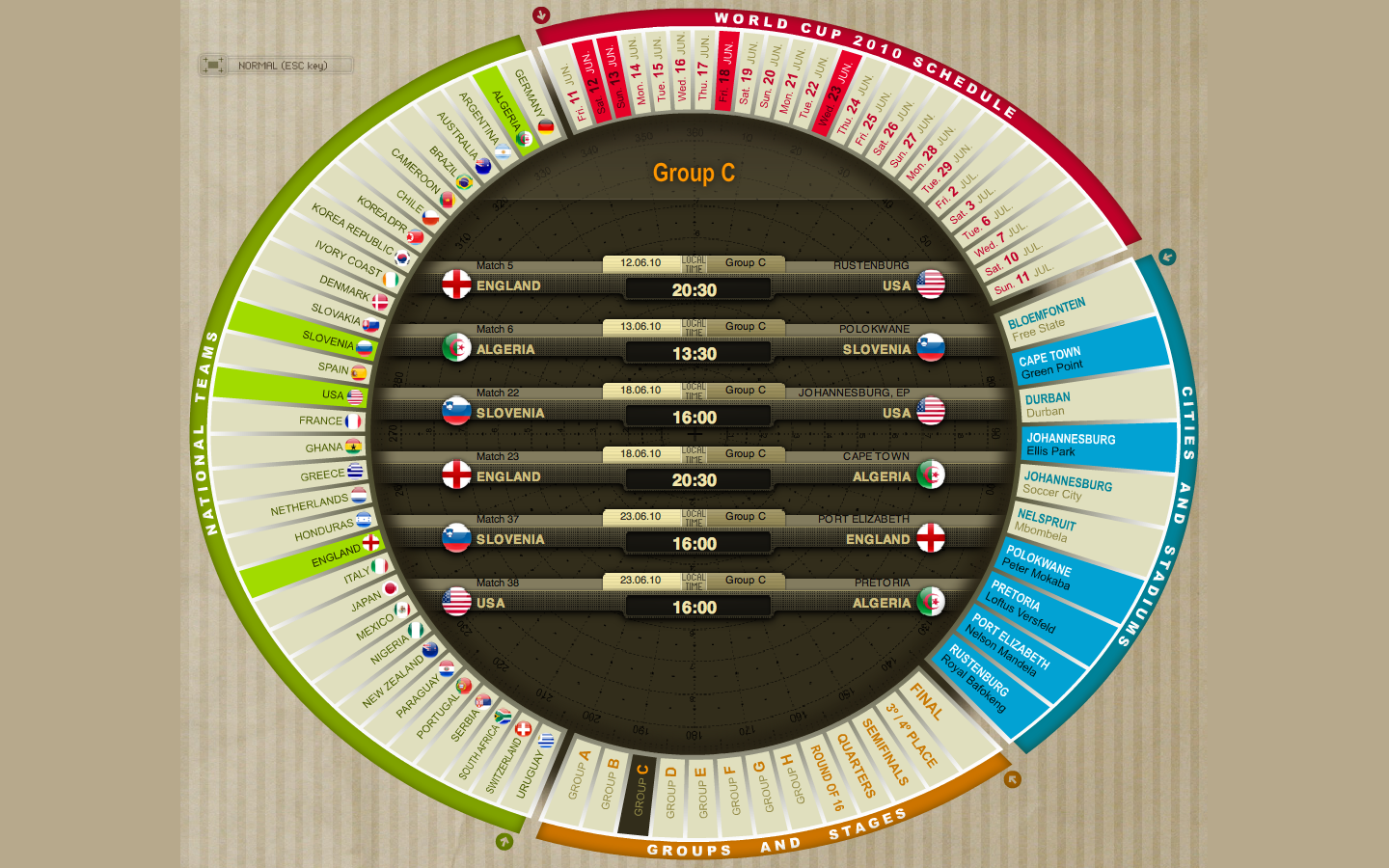
Twitter has made some auto-searches for the occasion, guaranteed to attract spam, along with some actual news and opinions. There’s an overall page along with a page for each game (e.g. South Africa vs. Mexico. Pages for each country (e.g. Mexico) give dates and times of upcoming matches. (Thanks Ranti and Richard for the tip.) 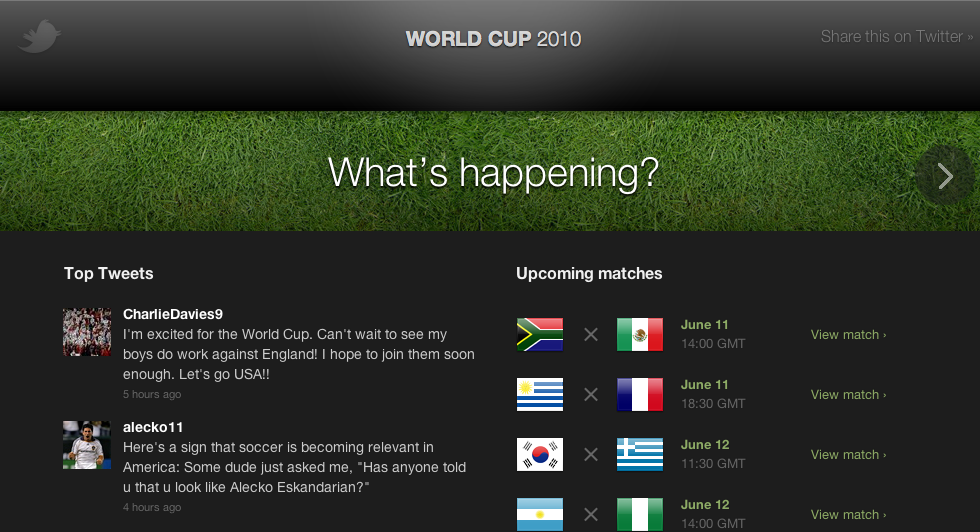
Tags: Ireland, soccer, sports, World Cup
Posted in random thoughts | Comments (0)
Enhancing MediaWiki Talk pages with Semantics for Better Coordination – a proposal (SemWiki 2010 short paper)
May 31st, 2010
Today Alex is presenting our short paper (PDF) at SemWiki. We describe an extension to SIOC for MediaWiki Talk pages: the SIOC WikiTalk ontology, http://rdfs.org/sioc/wikitalk.
The general line of research is to provide tools for arguing, convincing others, and understanding the status of a debate, in social media, with Semantic Web technologies. This is work in progress and suggestions and other feedback are most welcome.
Besides the short paper (PDF), these slides are also downloadable (slides PDF).
Tags: coordination, MediaWiki, Talk pages, Wikipedia
Posted in PhD diary, semantic web, social semantic web | Comments (0)