Difference between cakes and biscuits? When stale, cakes go hard, biscuits go soft. Hence Jaffa Cakes are cakes. (Was official EU ruling).
I just love this example:
First, you can find it with “hence” (see cue phrases from an appendix to Marcu‘s thesis).
Second, the notion of this EU (tax) ruling amuses me.
Third, it shows that 140 characters is enough for a complex argumentative structure. This has three main claims: When stale, cakes go hard, biscuits go soft; Jaffa Cakes are cakes; and [Jaffa Cakes are cakes due to] official EU ruling.
It’s hard, though, to draw the line between an argument and an explanation in this context. Jaffa Cakes, for you North American readers, are a common dessert-y snack in Ireland and the UK. Vaguely like Kandy Kakes found in the Philadelphia area/East Coast, but usually have an orange filling.
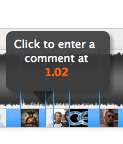
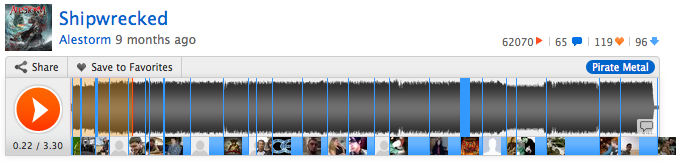
Today I noticed time-based comments in their tracks. It’s a bit disorienting to have comments pop up as you’re listening. Maybe after adjusting, there’s a pleasant sense of having a conversation going on around you. Definitely feels like you’ve got company!
Comments pop up as the track plays
Avatars appear below the track to indicate that there are comments, and you can scroll over avatars to read comments. You can also hide the comments if you prefer.
EPUB is just HTML + CSS in a tasty ZIP package. Let’s have more of it!
That’s the message of this 3 minute spiel I gave David Weinberger when he interviewed me at LOD-LAM back in June. Resulting video is on YouTube and below.
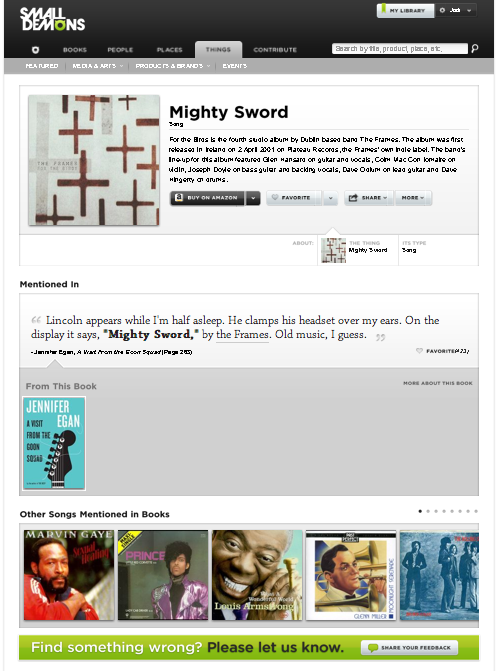
If you were building a user interface for the Web of data, for books, it just might look like Small Demons.
Unfortunately you can’t see much without logging in, so go get yourself a beta account. (I’ve already complained about asking for a birthday. My new one is 29 Feb 1904, you can help me celebrate in 2012!)
Their data on Ireland is pretty sketchy so far. They do offer to help you buy Guiness on Amazon though. :)
What are the laws of information? Frank van Harmelen proposes seven laws of information science in his keynote to the Semantic Web community at ISWC2011. ((He presents them as “computer science laws” underlying the Semantic Web; yet they are laws about knowledge. This makes them candidate laws of information science, in my terminology.))
Factual knowledge is a graph. ((“The vast majority of our factual knowledge consists of simple relationships between things,
represented as an ground instance of a binary predicate.
And lots of these relations between things together form a giant graph.”))
Terminological knowledge is a hierarchy.
Terminological knowledge is much smaller ((by 1-2 orders of magnitude)) than the factual knowledge.
Terminological knowledge is of low complexity. ((This is seen in “the unreasonable effectiveness of low-expressive KR”: “the information universe is apparently structured in such a way that the double exponential worse case complexity bounds don’t hit us in practice.”))
Heterogeneity is unavoidable. ((But heterogeneity is solvable through mostly social, cultural, and economic means (algorithms contribute a little bit). ))
Publication should be distributed, computation should be centralized to decrease speed: “The Web is not a database, and I don’t think it ever will be.”
Knowledge is layered.
What do you think? If they are laws, can they be proven/disproven?
I wish every presentation came with this sort of summary: slides and transcript, presented in a linear fashion. But these laws deserve more attention and discussion–especially from information scientists. So I needed something even punchier to share, (prioritized thanks to Karen).
Thanksgiving weekend doesn’t really register in Europe. But this year it will for me: I’m going to Amsterdam for Quantified Self Europe, since I’m lucky enough to have a scholarship covering conference fees.
Today I proposed two talks:
Weight and exercise tracking (which I’ve been doing in various forms for 19 months, currently using a Phillips DirectLife exercise monitor, and a normal scale, collected with the hacker’s diet). Mainly, these are less integrated than they could be, and I’d like to advocate interoperability, APIs, and uniform formats — while hopefully getting some ideas from the audience about quick hacks to improve my current system.
Lifetracking, privacy & the surveillance society. This brings together two themes: First, how individuals’ lifetracking can be seen as a re-enactment of privacy, with changed ideas of what that means (e.g. panopticon, sousveillance, etc.). Second, the increased awareness about the wealth of personal data held by corporations (e.g. German politician Malt Spitz sued to get 6 months of his telcom data). The boundary between public life and private life is continually shifting as communication technology and social norms evolve; this talk investigates how lifetracking and the quantified self movement push the privacy/publicity boundaries in multiple ways. QS increases the public audience for data-driven stories of private lives while also highlighting the need for individuals to control access to and the disposition of their own personal data.
Ironically, self-surveillance was an academic interest of mine before it became a personal one: Back in 2009, Nathan Yau and I wrote a paper for the ASIST Bulletin about self-surveillance (PDF) [less pretty in HTML]. It helped interest me in the Semantic Web, too: putting data in standard formats would make it easier to make data-driven visualizations, so lifetracking and the quantified self movement is a great usecase for the (social) Semantic Web. QS also shows how privacy cuts both ways and could provide an early-adopter audience for the kind of fine-grained privacy tools a colleague is developing.
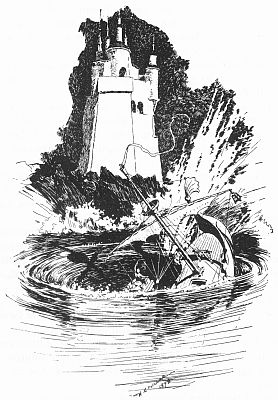
Sometimes people are important to you not for who they are, but for what they do. Michael S. Hart, the founder of Project Gutenberg, is one such person. While I never met him, Michael’s work has definitely impacted my life: The last book I finished ((The Book of Dragons, by Edith Nesbit: highly recommended, especially if you like silly explanations or fairy tales with morals.)), like most of my fiction reading over the past 3 years, was a public domain ebook. I love the illustrations.
The first personal computer: KENBAK-1 (1971)
In 1971, the idea of pleasure reading on screens must have been novel. The personal computer had just been invented; a KENBAK-1 would set you back $750 — equivalent to $4200 in 2011 dollars ((CPI Inflation Calculator)).
 Here’s an argument made on Twitter: