Turning social disputes into knowledge representations (DERI reading group 2012-03-28)

September 16th, 2012
by jodi

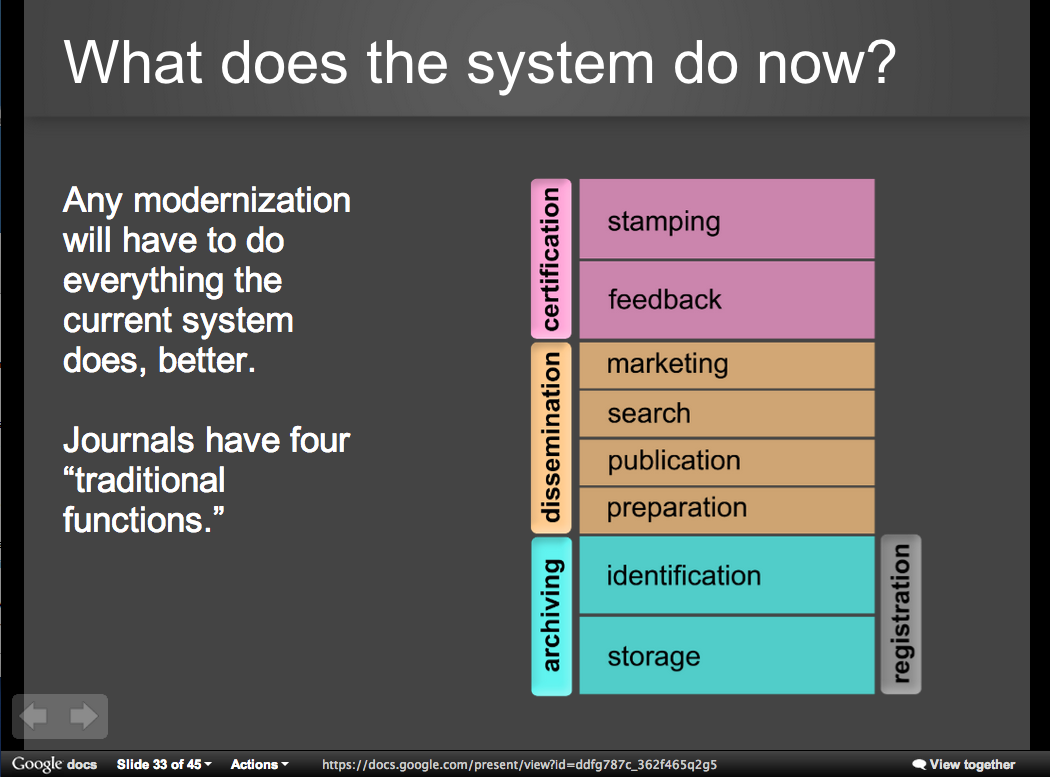
Last March ((March 28, 2012)) I gave a reading group talk about knowledge representations of online disputes:

Titled “Turning social disputes into knowledge representations”, the talk was based primarily on two papers:

Online argumentation, and particularly knowledge representation from argumentation, is the overarching theme of my dissertation at DERI and as I get together the overall argument, I’ve been looking through my old slidedecks. My previous reading group talk, from November 2011, was about Using Controlled Natural Language and First Order Logic to improve e-consultation discussion forums, based on several papers by Adam Wyner and his colleagues; more recently Adam and I have started a fruitful collaboration, funded in part by the COST action on argumentation and a Short-Term Travel Fellowship from Science Foundation Ireland.

Tags: , , , ,
Posted in argumentative discussions, PhD diary, social semantic web | Comments (0)

Temperature conversions for Americans living in mild climates

August 12th, 2012
by jodi

Converting temperatures in your head is a good trick for Americans living abroad.

So here’s the trick. You memorise the following correspondences:

0 °C = 32 °F
10 °C = 50 °F
20 °C = 68 °F
30 °C = 86 °F
Then, to convert any temperature that is near these, approximate 1 °C = 2 °F. This will allow you to convert almost any naturally occurring outdoor temperature in the UK in either direction to within 1° accuracy.

Let’s try it. As I write the current temperature in Edinburgh is 14 °C. This is 10 °C plus 4° extra. From memory convert the 10 °C to 50 °F. Then convert 4 °C extra to 8 °F extra and add it back on. This gives you 14°C = 58°F. This is not exact, but close enough that you know to wear a jumper. The exact formula is

14 * 9 / 5 + 32 = 57 F
Good luck doing that in your head.

from Charles Sutton’s Converting Fahrenheit into Celsius.

A jumper, for Americans, is “A pullover sweater.”

Tags: , , , ,
Posted in random thoughts | Comments (1)

Real-time LaTeX Collaboration

August 11th, 2012
by jodi

I’m still looking for real-time collaboration tools for LaTeX. I need to try shareLaTeX again. Sadly, LaTeX-lab (which layers ontop of Google Docs) is only designed for a single editor at a time (kind of defeating the purpose). Apparently, ScribTeX (discovered via pinboard search) is popular (and there’s also verbosus) — and sounds useful.

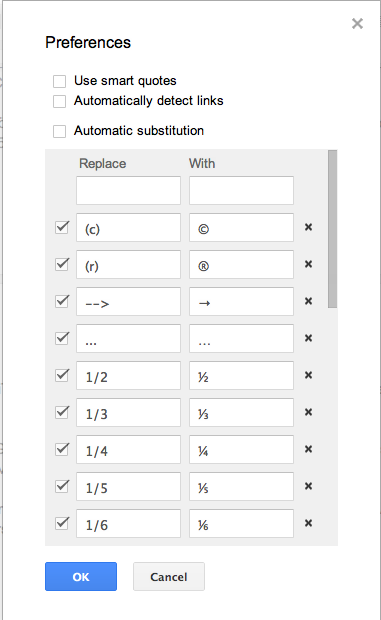
One of the sticking points of using Google Docs (which is useful at some points of the editing) was its use of smartquotes. That, at least is avoidable: Tools -> Preferences gives the option to disable smart quotes and automatic substitution.

Google Docs preferences - disable smart quotes

Tags: , , , ,
Posted in PhD diary | Comments (0)

Ontology Evaluation – an Essential Part of Ontology Engineering

July 26th, 2012
by jodi

James Malone reflects on a panel discussion on evaluation and reuse of ontologies. He wants there to be a “a formal, objective and quantifiable process” for “making public judgements on ontologies”. Towards that, he suggests that we need:

  1. A formal set of engineering principles for systematic, disciplined, quantifiable approach to the design, development, operation, and maintenance of ontologies
  2. The use of test driven development, in particular using sets of (if appropriate, user collected) competency questions which an ontology guarantees to answer, with examples of those answers – think of this as similar to unit testing
  3. Cost benefit analysis for adopting frameworks such as upper ontologies, this includes aspects such as cost of training for use in development, cost to end users in understanding ontologies built using such frameworks, cost benefits measured as per metrics such as those above (e.g. answering competency questions) and risk of adoption (such as significant changes or longer term support).

– James Malone, in Why choosing ontologies should not be like choosing Pepsi or Coke, about his International Conference on Biomedical Ontology panel ‘How to deal with sectarianism in biomedical ontology.

Tags: , , ,
Posted in semantic web | Comments (0)

“Excuse my typo” signature lines, a collection

July 16th, 2012
by jodi
For about a year I’ve been collecting email signature lines. After receiving an email purporting to be “Sent from my rotary phone” I thought it was time to share.
  • Touched, not typed
  • Sent from my $DEVICENAME
  • Consider any misspellings my gift to you
  • Typed with thumbs
  • Sent with mobile solution
  • Sent from a mobile operating system. Which one isn’t of any importance to you, the receiver. However, if you feel that knowing this detail would affect positively your reading of this email you can, of course, ask me.
  • Sent from my smartphone platform of choice….hint not a fruit
  • I prefer robots to fruit.
  • Fruits are for fruitcakes, Robots are for emailing.
  • bots best for smart phones
  • Smart fruit is an oxymoron
  • Sent via a really tiny keyboard
  • Sent from a mobile device. Erroneous words are a feature, not a typo.
  • Sent from mobile; pls excuse typos
  • $DEVICENAME = specific mobile operating system of choice
  • Sent from my stationary operating system of choice.
  • Erroneous words are a feature, not a typo.
  • (Short, curt and ill-formed message sent from my portable telephone machine.)
  • > Sent wirelessly from my BlackBerry device on the Bell network.
    > Envoyé sans fil par mon terminal mobile BlackBerry sur le réseau de Bell.
  • *Sent from a mobile phone – please excuse the brevity of the message
  • via small communication device/pardon random autocorrects and fat finger typos.
  • Warning: I either dictated this to my device, or I typed it clumsily. Expect typos and weirdness.
  • Sent from a mobile device. Excuse brevity and typos.
  • Typed by thumbs and sent by my Verizon Wireless gadget
  • Sent from a mobile device. Please excuse brevity and tpyos.
  • Sent from my Verizon Wireless 4G LTE smartphone
  • Sent from tiny touchscreen gizmo, excuse any auto correct nonsense that slips in…
  • Sent from my rotary phone
  • Sent with my thumbs (Thanks to Andy Powell.)
  • sent from my shoe (Thanks to Larry Hynes.)
  • Sent while walking into stuff(Thanks to Ryan Sarver (via Laura Dragan and Tim O’Reilly; used by David Cohen)

—
Previously discussed on Twitter (thanks to David Crowley and Becky Yoose for spreading my question). Apparently desktop users want forgiveness too.

Tags: , , ,
Posted in random thoughts | Comments (8)

Google Docs ‘research’ tab

May 19th, 2012
by jodi

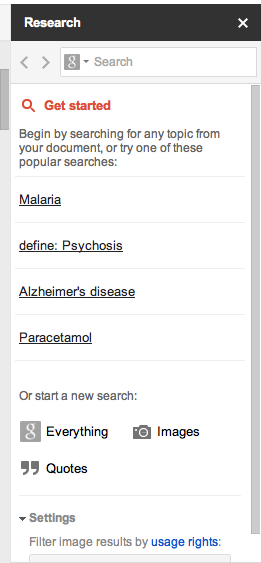
Increasingly, I’m using Google Docs with collaborators. Yesterday, one of them pointed out the new “Research” search tab within Google Docs. (Tools->Research). I’m a bit surprised that your searches don’t show up on your collaborators’ screen. I’m particularly surprised that sharing searches doesn’t seem possible.

Google Docs' new 'Research' tab promotes search within Google Docs.

Apparently, it is pretty new. More at the Google Docs blog.

Tags: ,
Posted in information ecosystem, random thoughts, scholarly communication | Comments (0)

Error reporting: it’s easier in Kindle

May 9th, 2012
by jodi

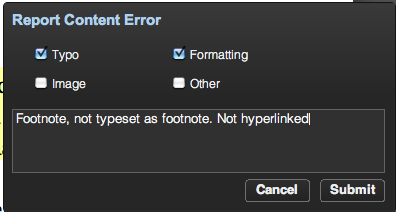
One thing I can say about Kindle: error reporting is easier.

You report problems in context, by selecting the offending text. No need to explain where - just what the problem is.

Feedback receipt is confirmed, along with the next steps for how it will be used.

By contrast, to report problems to academic publishers, you often must fill out an elaborate form (e.g. Springer or Elsevier). Digging up contact information often requires going to another page (e.g. ACM.). Some make you *both* go to another page to leave feedback and then fill out a form (e.g. EBSCO). Do any academic publishers keep the context of what journal article or book chapter you’re reporting a problem with? (If so, I’ve never noticed!)

Tags: , , , ,
Posted in future of publishing, information ecosystem, library and information science | Comments (0)

Attached?

May 7th, 2012
by jodi

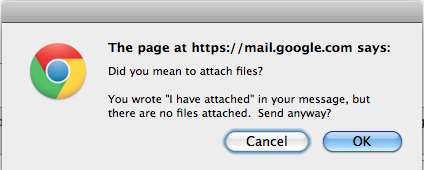
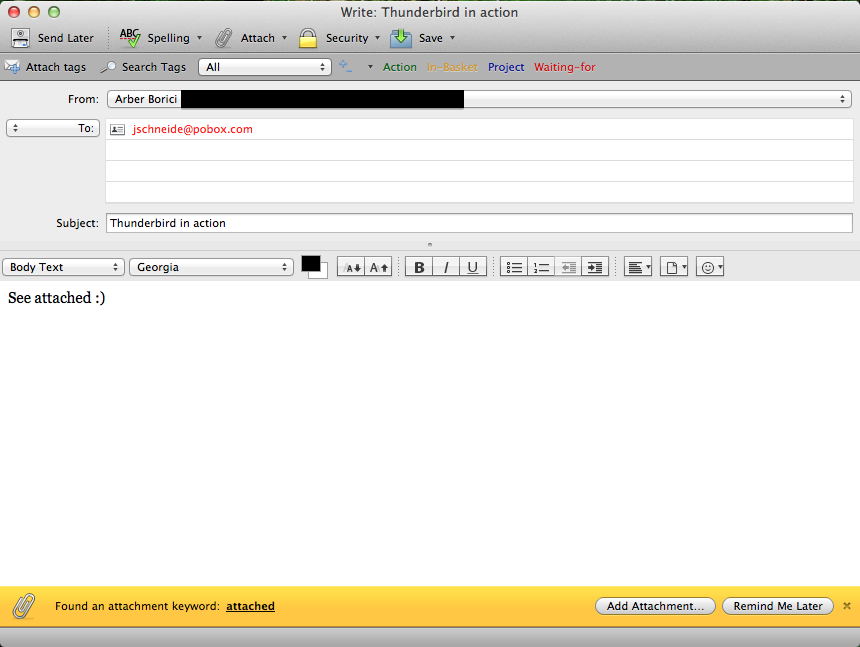
I noticed that GMail is warning about missing attachments and heard that Thunderbird does this, too, from Arber Borix, who also responded to a request for a screenshot (below). Thanks, Arber!

Thunderbird: Found an attachment keyword: attached. Add Attachment... Remind Me Later

Tags: , , ,
Posted in random thoughts | Comments (2)

Missing rhetorical connectives

May 7th, 2012
by jodi

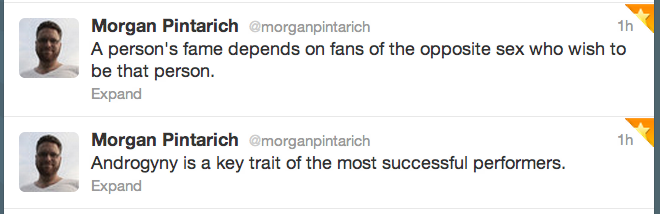
There may be an implied relationship between tweets (as between sentences) which is not made explicit.

Androgyny is a key trait of the most successful performers.
(Because)
A person’s fame depends on fans of the opposite sex who wish to be that person.

(via the twitterfunding list from the twitterfunding experiment).

See also: my favorite example argument on Twitter.

Tags: , , , , ,
Posted in argumentative discussions, PhD diary, social web | Comments (0)

Commercial Altmetric Explorer aimed at publishers

May 7th, 2012
by jodi

Altmetrics is hitting its stride: 30 months after the Altmetrics manifesto ((J. Priem, D. Taraborelli, P. Groth, C. Neylon (2010), Altmetrics: A manifesto, (v.1.0), 26 October 2010. http://altmetrics.org/manifesto)), there are 6 tools listed. This is great news!

I tried out the beta of a new commercial tool, The Altmetric Explorer, from Altmetric.com. They are building on the success and ideas of the academic and non-profit community (but not formally associated with Altmetrics.org). The Altmetric Explorer gives overviews of articles and journals by the social media mentions. You can filter by publisher, journal, subject, source, etc. Altmetric Explore has a closed beta, but you can try the basic functionality on articles with their open tool, the PLoS Impact explorer.

"The default view shows the articles mentioned most frequently in all sources, from all journals. Various filters are available.


Rolling over the donut shows which sources (Twitter, blogs, ...) an article was mentioned in.


Sparklines can be used to compare journals.


A 'people' tab lets you look at individual messages. Rolling over the photo or avatar shows the poster's profile.

Altmetric.com seems largely aimed at publishers ((“Altmetric sustains itself by selling more detailed data and analysis tools to publishers, institutions and academic societies.”, says the bookmarklet page, to explain why that is free)). This may add promotional noise, not unlike coercive citation, if it is used as an evaluation metric as they suggest: ((‘This quote from an editor as a condition for publication highlights the problem: “you cite Leukemia [once in 42 references]. Consequently, we kindly ask you to add references of articles published in Leukemia to your present article”’-from the abstract of Science. 2012 Feb 3;335(6068):542-3. Scientific publications. Coercive citation in academic publishing. Wilhite AW, Fong EA. summary on Science Daily.))

Want to see which journals have improved their profile in social media or with a particular news outlet?

Their API is currently free for non-commercial use. Altmetric.com are crawling Twitter since July 2011 and focusing on papers with PubMed, arXiv, and DOI identifiers. They also get data from Facebook, Google+, and blogs, but they don’t disclose how. (I assume that blogs using ResearchBlogging code are crawled, for instance.)

Tags: , ,
Posted in future of publishing, information ecosystem, random thoughts, scholarly communication, social web | Comments (0)