Archive for the ‘social web’ Category
Today at 3 (in Heidelberg) I’m running a breakout session on QS & Privacy: How can we ensure privacy as we share our data stories? What rights and responsibilities do we have? Where is the public-prviate boundary?
Here are a few provocative thoughts from conversations so far today.
Body Blogger Kiel Gilleade talked about heartrate this morning:
My boss called me to ask whether I was working on a deadline because my heart rate was in the green zone rather than in the red zone like the last paper-writing deadline.
He observes: situational & contextual info is crucial for interpretation.
Tom Hume tweeted:
You don’t control your identity. It’s manufactured by those around you. #qs2011
Joshua Kauffman tweeted:
There is no such thing as personal health data. All matters of health are socially shared and derived. #qs2011
Tags: privacy, QS11, QS2011, QuantifiedSelf, QuantifiedSelfEurope, self-surveillance
Posted in random thoughts, social web | Comments (1)
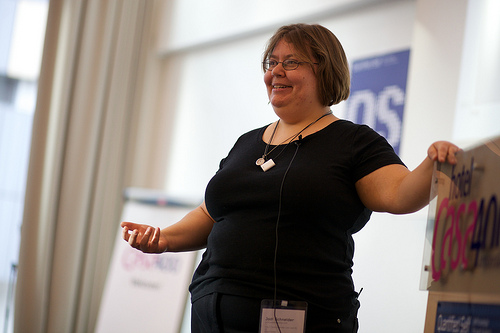
My talk on exercise and weight tracking at QuantifiedSelfEurope was video’d and will be world-viewable on the Quantified Self blog at some point in the future.
So far being visible has been beneficial, so despite the challenge, I’m sharing slides. As I said during the talk, an exercise monitor is something of a conversation piece: to ask a fat person “Are you trying to lose weight?” is generally rude. But an exercise monitor has been a point of entry to me for useful conversations and interesting ideas (like weight averaging and tracking tools).
I’ll add video when that’s available.
Tags: exercise tracking, QS11, QS2011, QuantifiedSelf, weight tracking
Posted in random thoughts, social web | Comments (2)
What is this Quantified Self stuff, anyway? Here’s a brief intro (prettier PDF version) Nathan Yau and I wrote.
This weekend I’m in Amsterdam for Quantified Self Europe. So far this morning I’ve met Arduino hackers, seen several talks about monitoring heart rate (continuously, cool, or even with swimming goggles) and lung capacity. Oh, and given a talk about Exercise and Weight tracking.
There’s lots of blogging/photoblogging going on. Twitter hashtag (formerly #QSelfEurope) is #QS2011.
Tags: QS11, QS2011, QuantifiedSelf, QuantifiedSelfEurope, self-surveillance
Posted in information ecosystem, random thoughts, social web | Comments (0)
 Here’s an argument made on Twitter:
Difference between cakes and biscuits? When stale, cakes go hard, biscuits go soft. Hence Jaffa Cakes are cakes. (Was official EU ruling).
I just love this example:
- First, you can find it with “hence” (see cue phrases from an appendix to Marcu‘s thesis).
- Second, the notion of this EU (tax) ruling amuses me.
- Third, it shows that 140 characters is enough for a complex argumentative structure. This has three main claims: When stale, cakes go hard, biscuits go soft; Jaffa Cakes are cakes; and [Jaffa Cakes are cakes due to] official EU ruling.
- Enthymemes anyone?
It’s hard, though, to draw the line between an argument and an explanation in this context.
Jaffa Cakes, for you North American readers, are a common dessert-y snack in Ireland and the UK. Vaguely like Kandy Kakes found in the Philadelphia area/East Coast, but usually have an orange filling.
Tags: argumentation, argumentative structures, EU tax law, informal argumentation, Jaffa cakes, Kandy Kakes, twitter, VAT
Posted in argumentative discussions, PhD diary, random thoughts, social web | Comments (4)
I’ve been digging SoundCloud lately.
Today I noticed time-based comments in their tracks. It’s a bit disorienting to have comments pop up as you’re listening. Maybe after adjusting, there’s a pleasant sense of having a conversation going on around you. Definitely feels like you’ve got company!
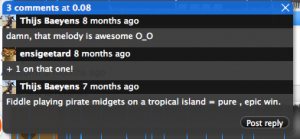
Comments pop up as the track plays
Avatars appear below the track to indicate that there are comments, and you can scroll over avatars to read comments. You can also hide the comments if you prefer.
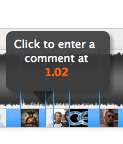
Entering a comment from the timeline
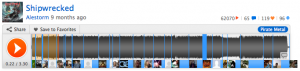
Avatar icons appear in the overview
Example track due to Duncan.
Tags: commenting, comments, SoundCloud, threaded discussions, time-based discussions, timelines
Posted in argumentative discussions, information ecosystem, PhD diary, social web | Comments (0)
A few weeks ago, I noticed something new on YouTube: an “I dislike this” button.

I wonder how long that’s been there?
When I talk about online argumentation, a frequent comment is “too bad there’s only +1 and Like; we need more expressivity”.
See related discussions:
Tags: dislike button, like button, online argumentation, opinions, YouTube
Posted in argumentative discussions, information ecosystem, PhD diary, social web | Comments (1)
Loro Aroyo gave a talk in DERI on Friday, based on her “Crowdsourcing community science” slide deck. She was in town for Smita‘s viva. This is a deck of interest to anybody in digital cultural heritage.
The slide on “Ways to use the crowd” seemed particularly useful to me:
- tagging & classification
- editing & transcribing
- contextualising
- acquisition
- co-curation
- crowdfunding
Posted in information ecosystem, PhD diary, social web | Comments (0)
“The only constant is change.” – Heraclitis
How well do you know Wikipedia? Get to know it a little better by looking at how your favorite article changes over time. To inspire you, here are two examples.
Jon Udell’s screencast about ‘Heavy Metal Umlaut’ is a classic, looking back (in 2005) at the first two years of that article. It points out the accumulation of information, vandalism (and its swift reversion), formatting changes, and issues around the verifiability of facts.
In a recent article for the Awl ((The Awl is *woefully* distracting. I urge you not to follow any links. (Thanks a lot Louis!) )), Emily Morris sifts through 2,303 edits of ‘Lolita’ to pull out nitpicking revision comments, interesting diffs, and statistics.
Tags: change, Wikipedia
Posted in books and reading, future of publishing, information ecosystem, library and information science, social web | Comments (0)
GetSatisfaction does so many things right. Smart, immediate feedback is one example.
A couple weeks ago, I noticed this message while adding a post:
“EASE UP ON THE ALL CAPS IN YOUR TITLE. It looks like you’re shouting”

This is great in several ways:
- It’s immediate.
- It makes a single, clear, personalized ((i.e. specific to the situation)) suggestion.
- It uses a familiar analogy (“shouting”) — helping to explain the perceived problem.
- It’s not enforced: this nudges the poster, but leaves them to make up their own mind.
- It hints at humor/puts the shoe on the other foot (by USING CAPS FOR THE START OF THE MESSAGE).
- It’s not overwhelming.
Like their mood feedback it’s lightweight and appears to be effective.
Figuring out appropriate ways of presenting people with the “right” feedback at the right time will be important for a lot of the work I’m doing!
Tags: feedback, GetSatisfaction, immediate feedback, Internet norms, social context
Posted in PhD diary, random thoughts, social web | Comments (0)
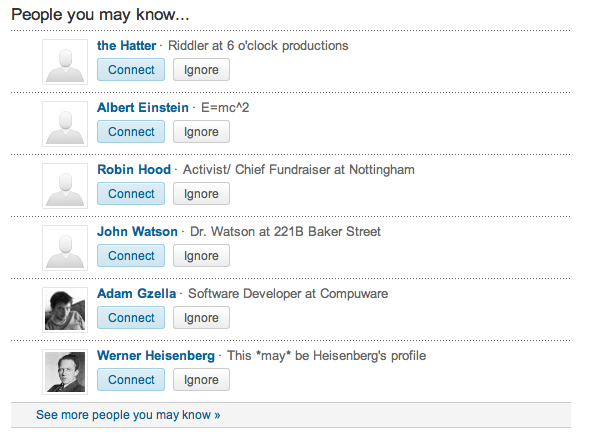
April Fools!
Alas, you need an email address to actually connect!
Tags: aprilfools, aprilfools11, aprilfools2011, linkedin
Posted in random thoughts, social web | Comments (0)

Time-based comments
I’ve been digging SoundCloud lately.
Today I noticed time-based comments in their tracks. It’s a bit disorienting to have comments pop up as you’re listening. Maybe after adjusting, there’s a pleasant sense of having a conversation going on around you. Definitely feels like you’ve got company!
Comments pop up as the track plays
Avatars appear below the track to indicate that there are comments, and you can scroll over avatars to read comments. You can also hide the comments if you prefer.
Entering a comment from the timeline
Avatar icons appear in the overview
Example track due to Duncan.
Tags: commenting, comments, SoundCloud, threaded discussions, time-based discussions, timelines
Posted in argumentative discussions, information ecosystem, PhD diary, social web | Comments (0)